


I’ve worked on a range of products and open-source projects, and there is something I feel strongly about.
There are far too few people who make things. Far too few.
Plenty of people use products, read articles, and gather information. Far fewer make something themselves, give it a concrete form, and put it out into the world. Before we even get to whether someone can make something or will share what they know, there are far too few people who think, “I’ll do it myself.”
Only a small number keep publishing regularly over the long term. Above all, the people who keep maintaining what they’ve made are a tiny handful.
Take GitHub’s statistics, for example. In 917 popular projects, 12.3% of people contributed to the same project for more than a year, 8.0% for more than two years, and 5.9% for more than three. In another 275, 48.98% of contributors committed only once. Of the 1,127 projects created in 2016, only 46.2% were still continuing after four years, and only 38.3% after five. Only some people start making things, yet even fewer keep making them, and fewer still keep maintaining them.
That’s why I want to support anyone who wants to make something. Whether it’s a product or an article, keep making things and putting them out there.
The concern that AI will lead to more meaningless content is no reason to stop.
Wanting to make something is valuable in itself
When you’re about to publish something new, it’s easy to think, “Something similar already exists,” “Someone more knowledgeable has written about this,” or “Is there any point in putting my version out now?”
But the existence of something similar doesn’t mean that what you need already exists.
The features may be there, but the purpose is slightly different. However detailed the explanation, it may leave out what you want to know or fail to present it in a way you can understand. Those mismatches are reasons to make something, too. When an existing option doesn’t fit, you start wanting something made to measure, rather than a customized version of what’s already available.
These days, an AI agent can do the job of a small tool. But what proportion of your workflow would you use it for? How often? How much time would that take? For a small task, you can give it instructions each time, or ask it to turn the steps into a script. But are you willing to keep adjusting slightly different methods across many steps, every day? Wouldn’t you want all of those methods made to measure? And wouldn’t simply sharing how you do this help someone with something?
You can start without an ambitious business plan or an idea no one has ever had before. You already have a place to use it in your life or work.
However many people start making things, meeting all these individual needs won’t be easy. That is why I feel there aren’t enough people who make things.
If it’s useful to you, it already has an audience
One concern about AI is that it will enable people to produce vast amounts of content that resonates with no one.
Simply generating huge quantities of things that help no one and mean nothing to anyone, just to get views: I agree that there is no value in that.
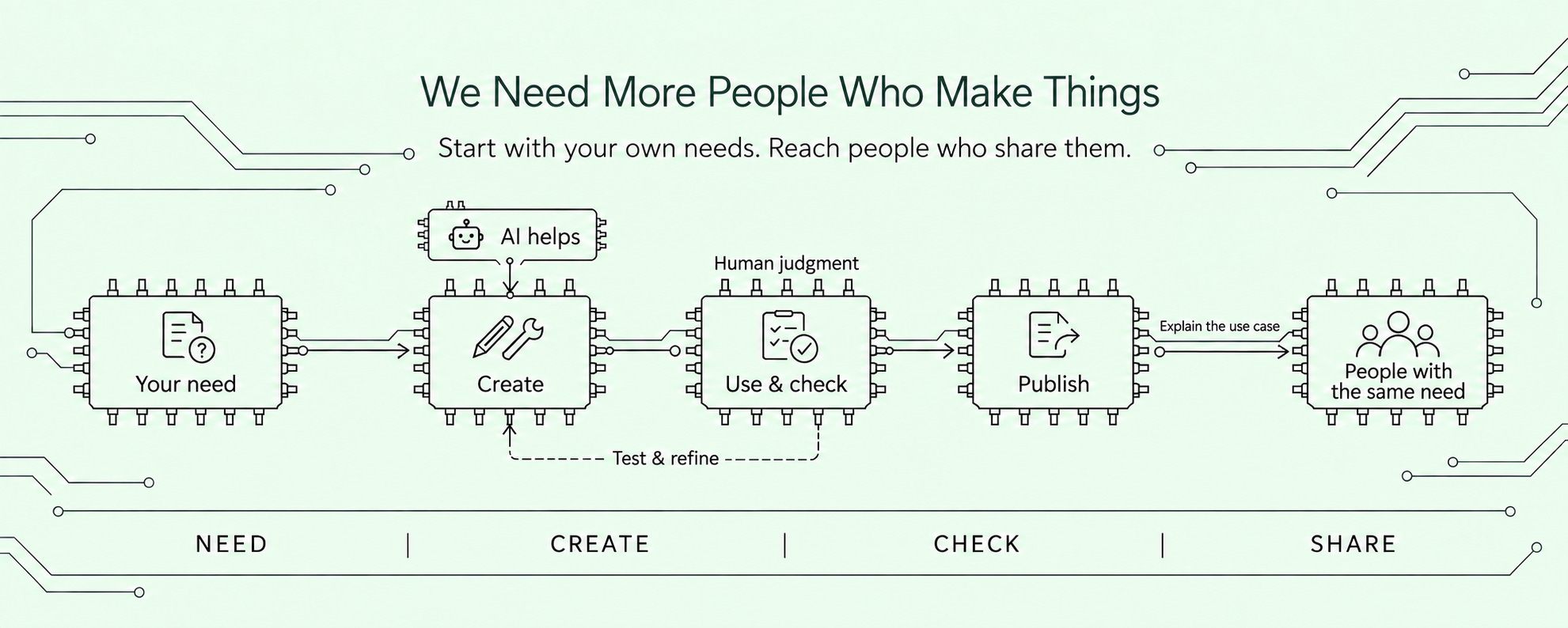
But people control what AI produces. Someone decides what to make, checks what comes back, revises it to fit a purpose, and gets it to the point where it can actually be used. Human judgment is part of that process.
And if something you made for yourself is genuinely useful to you, it has already reached at least one person. That person is you.
Before worrying that no one might need what you’ve made, don’t overlook this. A tedious task has become easier. Something you didn’t understand now makes sense. Something you wanted is now yours to use. There is a concrete use for it, and someone who benefits.
To me, the use case is everything. Why are you making it? Where will you use it? What will it improve? If you have clear answers for yourself, that is reason enough to get to work.
Using AI doesn’t erase that value. Check that the result fits your purpose. If it’s an article, verify the content. If it’s a tool, test how it works. Use what AI can do while exercising your judgment and taking responsibility as its creator.
For someone with the same use case, across time and place
The problem you face may not be yours alone. Someone else may do the same work, follow a similar process, or get stuck in the same place. Your future self, for one, is bound to get stuck in the same place again. Even if someone isn’t here at the same time as you, your work could very well be useful to them minutes, hours, or years from now.
Information published on the internet travels across time and place. You don’t know when or where someone will read it. That’s why, when I write a technical article about something specific, I lay out the prerequisites: when the information was current, the environment, and the circumstances. I also explain the problem I was facing, what I wanted to use the result for, and what I did or asked AI to do. What actually happened? What couldn’t I get to work?
It may come as a surprise, but sharing what you couldn’t do is also extremely important.
With systems and programs, there will always be compatibility problems involving particular versions somewhere. When a combination of package versions causes a problem in your environment, being able to check whether that problem is reproducible is extremely valuable.
“This is how I got it to work” and “This is how I solved it” are valuable information in their own right. But “I tried this and it still didn’t work” and “I couldn’t solve it no matter what I tried” are also extremely useful. People on the internet even work on things like porting old programs to different environments. Across time and place, people need to know both what works and what doesn’t.
Sharing these anti-patterns, alongside your successes, can help someone across time and place.
Keep making or keep sharing, even if you can only do one
The difficult part here is working out how to get your work to people. Is it going undiscovered? Is it unclear what it’s useful for? Do people find it but get stuck when they try to use it? A lack of response alone won’t tell you where things are getting blocked.
If your work hasn’t reached people, you don’t have to conclude immediately that making it was pointless. You may be able to change the words you use to explain its purpose, or where you show it. Feedback from people who use it may help you improve the work itself. There is room to improve both what you make and how you get it to people.
Try a different title, change how you explain it, add an illustration, or make it easier to get started. Share it somewhere with a different readership. Simply adapting how you present and distribute something to suit the work can give it a different form.
You don’t have to stop sharing just because you haven’t made something new. You can keep sharing what you’ve already made, making small adjustments, bringing the presentation into better alignment with the people you want to reach, and changing your approach.
Make what you want to make, and put it out there
I welcome more people making things with AI. Someone who wants to create something gains the ability to do it. I want to see more of that.
You don’t need to hold back from creating just because you’re worried about the growing volume of worthless output. Make something for yourself, use it, and check it yourself. Then try putting it out in a form someone else can use.
If there’s something you want to make, start talking to AI and turn it into something real. It could be a product that changes your daily work or an article with the explanation you wish you’d had. Put it out there, with the context of when and where it applies, what it’s for, and how to use it.
We still need far more people who make things. Keep making things. Keep putting them out there.